
Mutual Funds
ANNI Shofan Investment Management Ltd. is an external investment manager for Mutual Funds managed by sigma Mutual Funds Ltd. and therefore is affiliated with sigma Mutual Funds and is also affiliated with financial assets issued or managed by it. Following is a list of assets:
Shofan (2B) 20/80
Fund Manager:
Sigma Mutual Funds Ltd

Fund Trustee: mizrahi tefahot trust company ltd
Fund Name: Shofan (2B) 20/80
Security Number: 5127139
Tax Classification: Exempt
Management Fee: 0.82% (1) of the average annual net worth of the Fund’s assets
External Investment Manager:
ANNI Shofan Investment Management Ltd.

Fund Investment Policy
The rate of exposure in the fund to bonds of any type, deposits and cash shall not be less than 80%, provided that the rate of exposure in the fund to bonds traded in Israel shall not be less than 75%.
The cumulative exposure rate to other channels (in accordance with the provisions of the law in this matter) that are not bonds of any kind
traded in Israel will not exceed 25% of the net value of the fund’s assets.
The rate of exposure in the fund to shares, in absolute value, shall not exceed 20%.
The rate of exposure in the fund to foreign exchange, in absolute value, shall not exceed 30%.
The rate of exposure to bonds that are not investment rated plus the rate of possible exposure of the fund to corporation with no affiliation with/to Israel (except if the rating of said bonds is AAil or higher or an equivalent rating(2) and plus the rate of exposure to credit risk of banking corporations or brokers that are not among The first credit risk group (3) shall not exceed 30% of the net value of the fund’s assets, provided that:
A. The rate of credit risk exposure of all banking corporations and brokers that are not included in the first credit risk group shall not exceed 20%.
B. The rate of credit risk exposure of a particular banking corporation or broker that is not included in the first credit risk group shall not exceed 10%.
The overall value of foreign securities, units of Foreign Funds, open tracking Mutual Funds, whose tracking asset is a foreign or commodity index, and foreign currency, which will be held by it, plus the exposure to an underlying asset traded abroad through activity in derivatives on foreign exchanges, will not exceed 10% of the net asset value of the Fund.
The balance of exposure will be determined at the sole discretion of the Fund manager
1) The fund manager undertook to act in accordance with the outline of the Securities Authority regarding the increase of management fees in the funds, according to which he will not increase the fund manager’s salary or the rate of addition (hereinafter collectively: “salary”) in funds managed during a calendar year. The fund manager will be able to raise his salary in the fund only on 1.1 each year. (Details regarding additional exceptions to the aforesaid obligation are presented in the report dated 03/03/2016 Reference: 2016-03-040243).
2) “Non-Investment Grade Bonds” – Corporate bonds and/or bonds issued by a foreign country (other than the State of Israel) that are unrated or rated below investment grade (lower than BBB-) or an equivalent rating.
“A corporation with no affiliation with/to Israel” – As the term is defined in the directive to fund managers regarding the addition of an exclamation mark to a fund’s name (New Version – 2026) and/or as otherwise defined, from time to time, in the relevant legal provisions
In the event that a downgrade of bonds held by the fund to a level below investment grade, or a downgrade of bonds issued by corporations with no affiliation to Israel below a rating of AAil or higher (or an equivalent rating), results in a deviation from the fund’s investment policy, continuing to hold such bonds in the fund shall not be deemed a breach of the prohibition against deviating from investment policy for a period of ten days from the date the deviation commenced.
It is clarified that, in accordance with the new directive, where a corporation ceases to have affiliation to Israel in a manner that leads to a deviation from the fund’s investment policy, continuing to hold the corporation’s bonds in the fund shall not be deemed a breach of the prohibition against deviating from investment policy for a period of three months.
3) With respect to this section, vis-à-vis the definition of credit risk groups and any deviation from said – see the directive for fund managers and trustees regarding custodial risks and credit risks. A bank that holds cash and deposits (of the Fund’s assets) deposited with it from a risk group that was rated lower than it or ceased to be rated according to the risk groups in the appendix to the directive, in such a manner that the Fund has deviated from said, its investment policy or the provisions of the directive, the continued exposure of said bank shall not be considered a breach of said directive from exception to any investment policy for ten trading days from the date the deviation began.
The Fund’s exposure profile is a combination of two characteristics representing the Fund’s maximum exposure rate to equities (in a scale consisting of the numbers 0 to 6) and to foreign currency (in a scale consisting of the digits 0 and the letters A to F). The higher the number or letter on the scale, the higher the maximum exposure.
2) 2- to 30% exposure to shares at absolute value, B- up to 30% exposure to foreign currency at absolute value.
This publication does not constitute an offer to acquire units in the Fund, any acquisition will be made according to the Fund’s binding Prospectus and changes in any Immediate Reports. That said is not construed as an alternative to advice/investment marketing provided by a holder of a license issued under law, that considers the specifics and requirements of each party. That said is not construed as an offer for the acquisition of participation units of Mutual Funds. The Fund’s past returns are not construed to ensure a similar return in the future.
That said should not be considered a commitment by the Fund manager to achieve any specific return.
* Although the Mutual Fund is tax-exempt, it may be liable to a tax on income and gains from securities abroad, said in addition to a tax that the Fund unit holder will pay on the redemption of units he held vis a vis the gain accrued on the units redeemed.
In addition, it should be noted that the information published on the company’s website does not constitute a substitute for individual investment advice that considers the client’s needs and should not be construed as any commitment whatsoever by the company to provide any service to the client. In addition, that published on the internet website should not be construed as any recommendation to make investments in the capital markets or any recommendation to invest in any financial assets.(
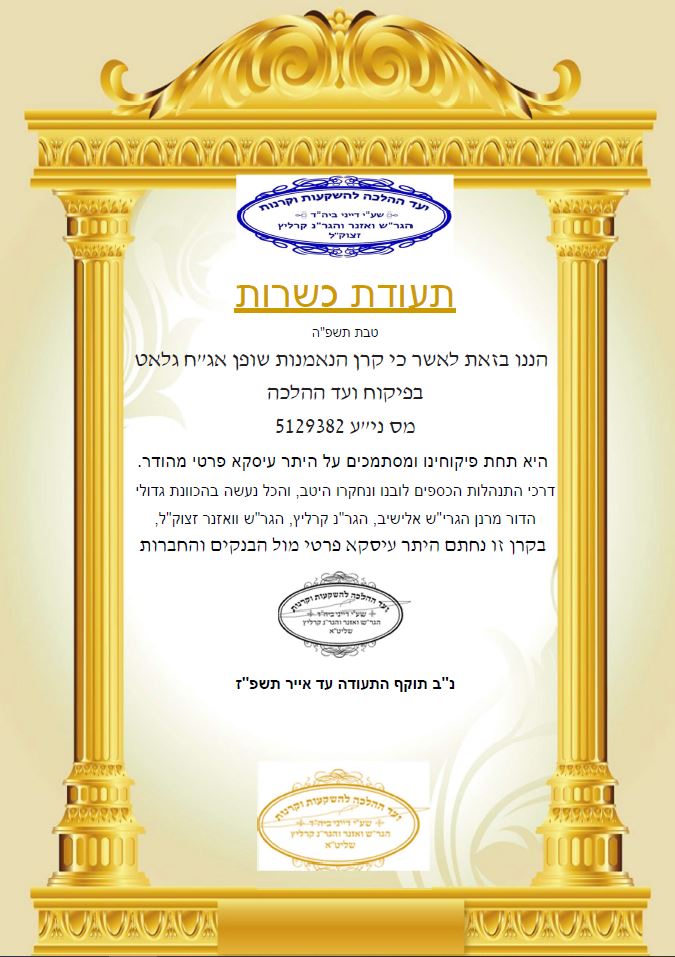
Shofan (OB) Glat Bond in supervision of Rav Vozner and Rav Karelitz Vaad Halacha
Fund Manager:
Sigma Mutual Funds Ltd
Fund Trustee: Mizrahi tefahot trust company ltd
Fund Name:
Shofan (OB) Glat Bond in supervision of Rav Vozner and Rav Karelitz Vaad Halacha IL
Fund Number: 5129382
Tax classification – exempt *
Management Fee: 0.89% (1) of the average annual net worth of the Fund’s assets
External Investment Manager:
ANNI Shofan Investment Management Ltd.
Fund Investment Policy
1. The fund manager undertakes that the fund’s assets will be exposed only to securities that are deemed suitable for investment from a halachic point of view (such as securities that does not involve interest, the prohibition of Shabbat and lavin) in securities with the evaluation and supervision of the Halacha Committee for Investments and Funds (Glat Houn) Judges of the Court of Appeals Hagarsh Wazener and Hagran Karlitz Shalita (hereinafter: “the committee”). To comply with this directive, the committee will deliver to the fund manager a list of securities traded on stock exchanges or a regulated market, approved by the committee, from which the fund manager will purchase Securities in favor of the fund. Securities that are not included in the list will not be purchased for the fund until the approval of the committee is received, according to which securities are suitable for investment from a halachic point of view.
2. The rate of exposure in the fund to bonds traded in Israel will not be less than 75%.
3. The cumulative exposure rate to other channels (in accordance with the provisions of the law in this matter) other than bonds traded in Israel shall not exceed, in absolute value, 25% of the net value of the fund’s assets.
4.The fund will not create exposure to stocks .
5. The rate of exposure in the fund to foreign exchange shall not exceed 20% in its absolute value.
6. The fund will not create exposure to bonds that are not rated investment and/or to corporation with no affiliation with/to Israel (except if the rating of said bond is AAil or higher or an equivalent rating[2]
7. The rate of exposure to credit risk of banking corporations or brokers that do not belong to the first credit risk group[3] , shall not exceed 20% of the net value of the fund’s assets, provided that:
A. The rate of exposure to credit risk of all banking corporations and brokers that do not belong to the first credit risk group could not exceed 20%.
B. The exposure rate to credit risk of a certain banking corporation or broker that is not included in the first credit risk group could not exceed 10%.
8. The total value of foreign securities, units of foreign funds, open-ended mutual funds, whose tracking asset is a foreign index or commodity, and foreign currency, which will be held in addition to the exposure to the base asset traded abroad through derivative activity on foreign exchanges shall not exceed 10% of the net value of the fund’s assets.
9.The remaining assets will be invested at the absolute discretion of the fund manager.
(1) The fund manager undertook to act in accordance with the outline of the Securities Authority regarding the increase of management fees in the funds, according to which he will not increase the fund manager’s salary or the rate of addition (hereinafter collectively: “salary”) in funds managed during a calendar year. The fund manager will be able to raise his salary in the fund only on 1.1 each year. (Details regarding additional exceptions to the aforesaid obligation are presented in the report dated 03/03/2016 Reference: 2016-03-040243).
(2)“Non-Investment Grade Bonds” – Corporate bonds and/or bonds issued by a foreign country (other than the State of Israel) that are unrated or rated below investment grade (lower than BBB-) or an equivalent rating.
corporation with no affiliation with/to Israel- As the term is defined in the directive to fund managers regarding the addition of an exclamation mark to a fund’s name (New Version – 2026) and/or as otherwise defined, from time to time, in the relevant legal provisions.
In the event that a downgrade of bonds held by the fund to a level below investment grade, or a downgrade of bonds issued by corporations with no affiliation to Israel below a rating of AAil or higher (or an equivalent rating), results in a deviation from the fund’s investment policy, continuing to hold such bonds in the fund shall not be deemed a breach of the prohibition against deviating from investment policy for a period of three months from the date the deviation commenced.
It is clarified that, in accordance with the new directive, where a corporation ceases to have affiliation to Israel in a manner that leads to a deviation from the fund’s investment policy, continuing to hold the corporation’s bonds in the fund shall not be deemed a breach of the prohibition against deviating from investment policy for a period of three months.
(3) With respect to this section, the definition of credit risk groups, and deviations from said – see the directive for Fund managers and trustees regarding custodial and credit risks. A bank that holds cash and deposits of Fund assets deposited with it from the risk group in which it was rated lower than it or ceased to be rated according to the risk groups in the appendix to the directive, in a manner that deviates from the Fund’s name, the continued exposure of said bank shall not be considered a breach of said directive from exception to its investment policy for ten trading days from the date the deviation began.
- “Fund benchmark asset” – general bond index **
** The Fund’s benchmark asset is an index or asset, which the Fund Manager believes is expected to change in value, or increase in value, and will have the most significant impact on the Fund’s return.
- 0 = no exposure to shares. B – up to 30% exposure to foreign currency in absolute value
- The Fund’s exposure profile is a combination of two characteristics representing the Fund’s maximum exposure rate to equities (on a scale consisting of the numbers from 0 to 6) and to foreign currency (on a scale consisting of the digits 0 and the letters A to F). The higher the number or characteristic on the scale, the higher the maximum exposure.
* Although the Mutual Fund is tax-exempt, it may be liable to a tax on income and gains from securities abroad, said in addition to a tax that the Fund unit holder will pay on the redemption of units he held vis a vis the gain accrued on the units redeemed.
In addition, it should be noted that the information published on the company’s website does not constitute a substitute for individual investment advice that considers the client’s needs and should not be construed as any commitment whatsoever by the company to provide any service to the client. In addition, that published on the internet website should not be construed as any recommendation to make investments in the capital markets or any recommendation to invest in any financial assets